How to Mount a DartSolar on a Truck or Van
A DartSolar is a 500-watt module, not a one-size kit. Closed, it is 58 × 24 × 3 inches and 45 pounds. It bolts to ordinary roof-rack crossbars, opens to three panels in about ten seconds, and ends in a single XT60 plug. Because every DartSolar is the same, the question for a truck or van owner is not whether it fits but how many to carry and which way they should open. This article covers the three layouts we use most: a van roof carrying 2,000+ watts, a pickup carrying 1,000 watts from the cab rack alone, and a pickup carrying 2,000 watts with DartSolars expanded side to side over the cab and the bed. It ends with the part people notice first in person: when the panels cantilever out past the vehicle, they make shade.
On a Van: 2,000+ Watts
A cargo van roof is the easiest DartSolar install there is: long, flat, and built to carry weight. Mount the modules across the van, one behind the next down the length of the roof, and expand them side to side. Closed, each takes 24 inches of roof length, so a high-roof Transit, Sprinter, or ProMaster holds four or five depending on wheelbase. The Ford Transit in the photos is carrying over 2,000 watts this way, and it still looks like a cargo van when it is closed up: 3 inches of height, nothing hanging past the mirrors.
What that buys you: a 1,000-watt setup makes about 5,000 watt-hours on a full day of sun in most of the country, so a 2,000-watt van roughly doubles that. That runs a fridge, an induction cooktop, laptops, and a fan all day with a surplus banked for the night, or it puts a meaningful daily charge into an electric van. And because the static panels keep working while the expanding panels are stowed, about a third of the array, roughly 650 watts on a 2,000-watt roof, is charging the whole time you drive.
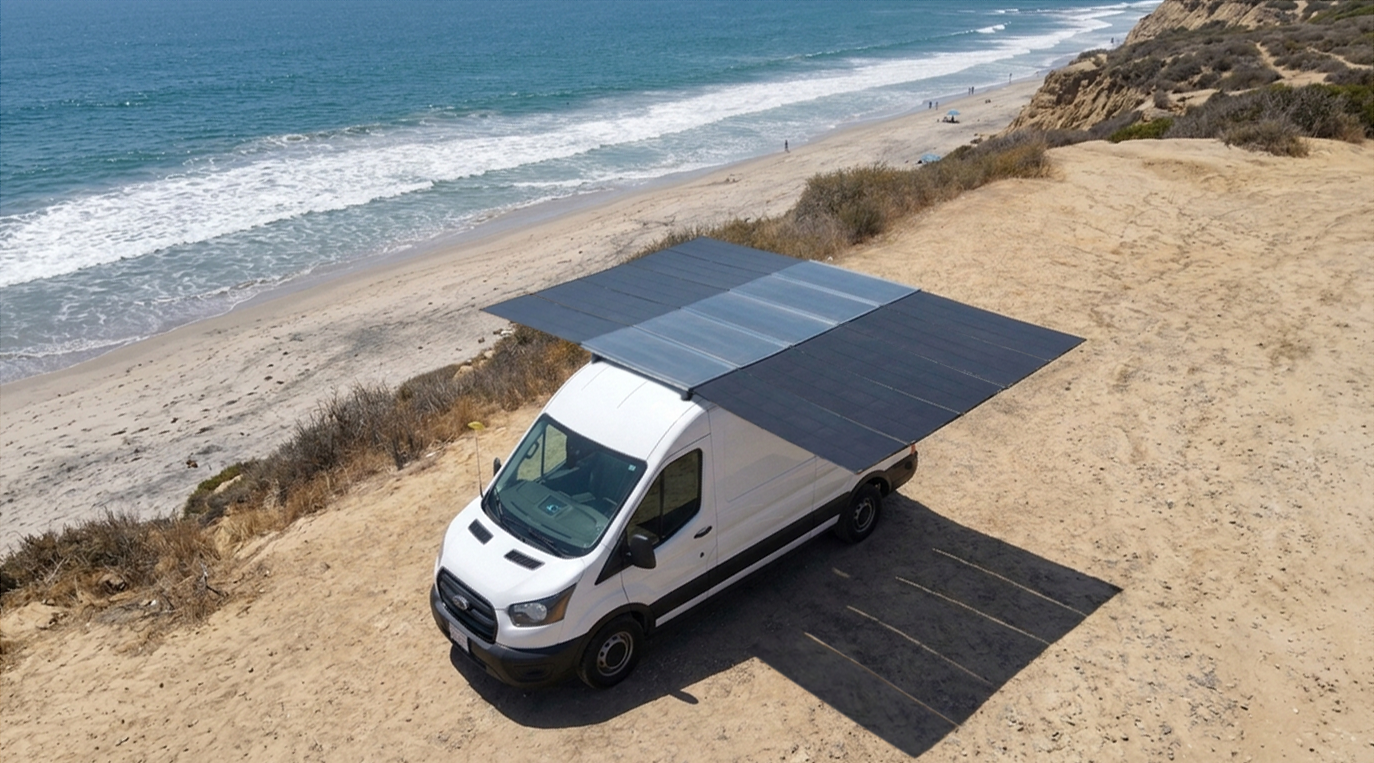
2500 solar watts installed on a van
On a Pickup: 1,000 Watts From the Cab Alone
The simplest truck layout needs nothing but the cab's roof rack. Mount two DartSolars side by side on the cab, running front to back. Closed, they sit 3 inches above the crossbars. Open, the front panels reach out over the windshield and hood, and the rear panels reach back over the bed: 1,000 watts, with the bed completely free. No bed rack, and no change to how you load the truck. The Toyota Tacoma in the photo is running this layout. Notice that the bed sits in shade under the rear panels, which makes it a better place to work out of on a July afternoon.
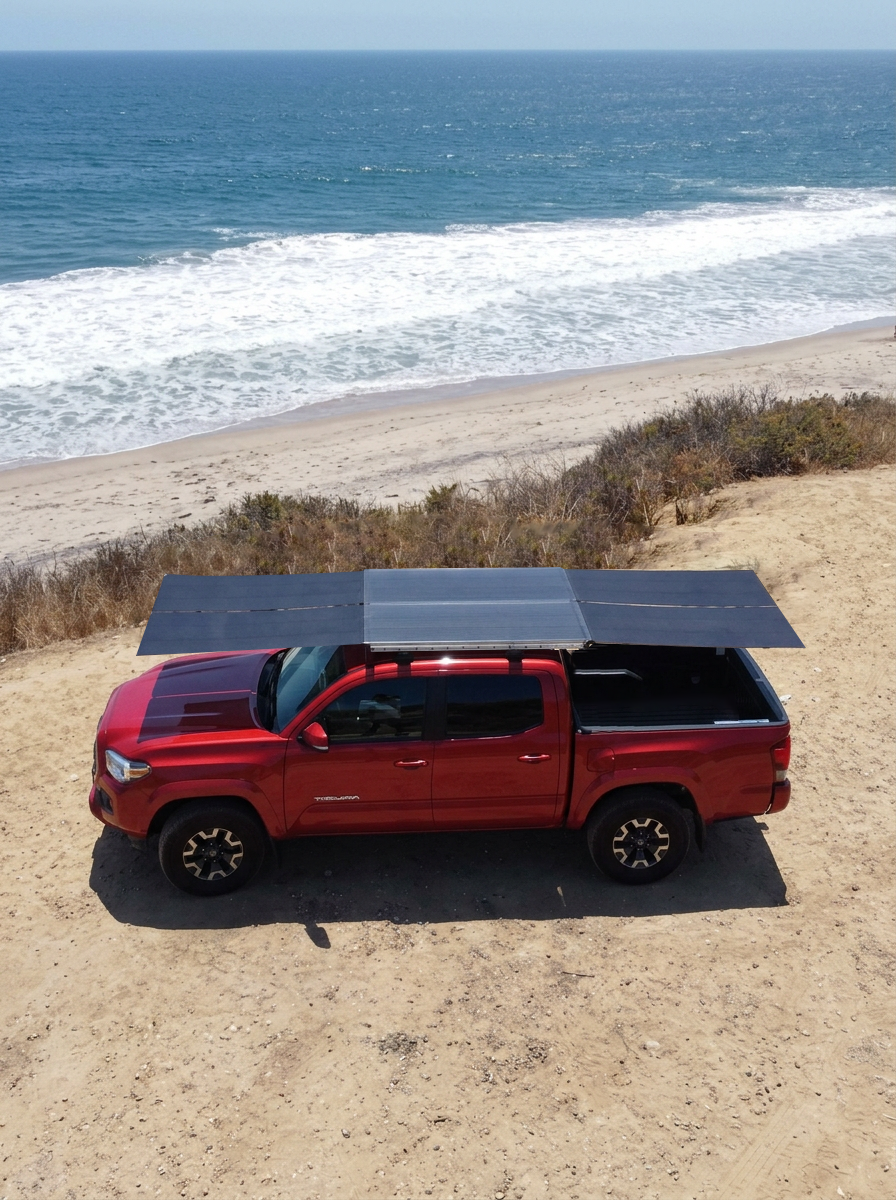
1000 solar watts installed on a truck
On a Pickup: 1,500 Watts, Expanded Side to Side
A pickup has two roofs once a bed rack is on it. Mount the DartSolars across the truck instead of along it, and expand them side to side: the static panel stays over the rack, and the telescoping panels cantilever out over both sides of the truck. Running them across is what frees up the length. One DartSolar fits the cab rack, and a bed rack on a 5- to 6.5-foot bed takes two or three more, lined up front to back, for 1,500 to 2,000 watts total. The Rivian R1T in the photo has one on the cab and two over the bed, with the bed itself still open for gear underneath. Any bed rack with crossbars works; a cab-height rack puts the bed modules on the same plane as the cab module, which keeps the open array flat.
One wiring note for bed mounts. When the sun is low, the cab throws shade across part of a bed-mounted module that sits below roof height. Run bed modules in the 30-volt parallel setup, which keeps producing when part of the array is shaded, and save the 90-volt series setup for modules that see the sun unobstructed. The Best Power Units for Your DartSolar lists which power units accept each.
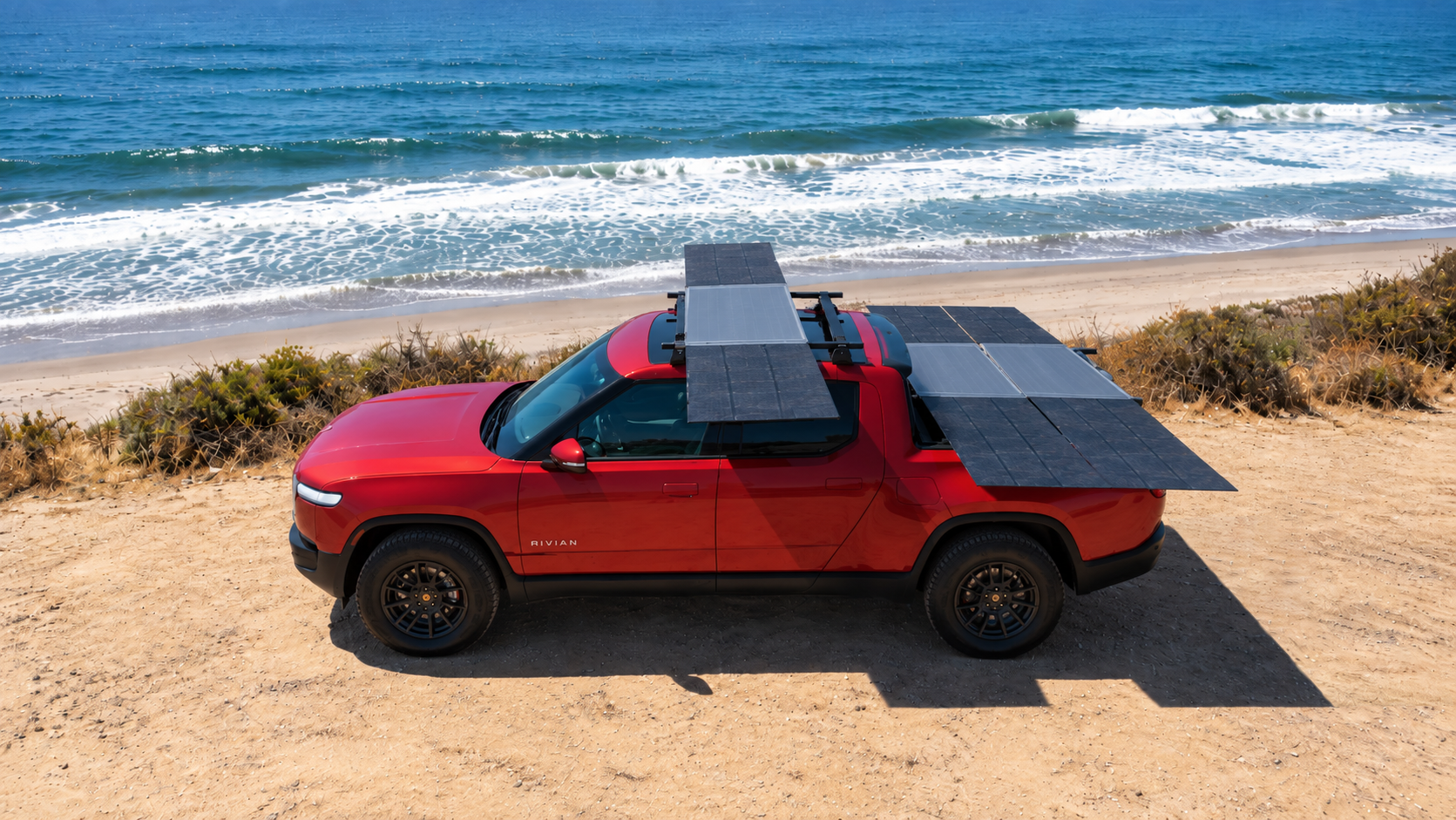
1500 solar watts on truck covering the truck bed as well
The Panels Are an Awning
Expanded side to side, a DartSolar cantilevers about four feet past each side of the vehicle. There are no poles, no guy lines, and no fabric to roll up: the aluminum telescoping tubes carry the panels out from the rack, which is why the Transit in the photos has a patch of shade beside its sliding door the size of a campsite kitchen. Two fingers open it in ten seconds, and the same motion closes it when the wind picks up.
That last part is the rule to remember. Fully expanded, a DartSolar is rated for gusts up to 25 mph. The shade also has a quieter benefit: a vehicle parked under its own panels keeps its cabin about 15 degrees cooler, which is less air conditioning to run when you get back in.
Before You Order
Add up the weight. 45 pounds per DartSolar: 90 pounds for a two-module truck, 180 to 225 for a four- or five-module van. Check your rack's and roof's dynamic load rating against that number before you buy the modules, not after.
Pick the orientation first. Front to back needs clear space over the hood and tailgate and gives you one module per row. Side to side needs clear space beside the vehicle and lets you line modules up along the roof. You can change your mind later; the module is the same either way.
Plan the wiring once. Decide between 30-volt parallel and 90-volt series based on your power unit's solar input and on shade. Bed mounts go parallel.