

Opens in seconds.
It slides open and slides closed. About the
same effort as opening a car door.
Start today.
From $1,350, or $113/mo.* Free delivery.
Charge & Drive
Charges as you drive.
More when you park.
Charges as you drive with one-third of the solar capacity.
Park, expand, and charge with all your solar panels.
Driving. One panel charges your power unit.
Parked. All three panels go to work.
What people are saying
Four newsrooms on DartSolar.
DartSolar isn’t just about innovation; it’s about practicality.
DartSolar ... soaks up the maximum amount of sunlight.
…the company’s midlevel, 1,000-watt system could add 10 to 20 miles of range to a parked Tesla...
...the solar roof rack can add a useful amount of range..
Cooler cabin
A cabin that is 15 degrees cooler.
DartSolar shades your vehicle and cools the cabin by 15 degrees, offsetting air conditioning.
Expandable rooftop solar for camping, overlanding
and off-grid living. And for blackouts.
Each solar panel
A tenth of an inch thick.
A DartSolar is three of these panels, one on top of the other. Each 170-watt panel is about 0.1 inch (2.5 mm) thick, 54 × 23 inches, and built in layers.
- ETFE coatingThe outer surface of the sheet.
- Half-cut 182 mm solar cells170 watts and 30 volts per panel.
- PETPart of the panel sheet.
- Fiberglass backingThe stiff layer behind the cells.
Layer order shown for illustration.
Five reasons, one card at a time.
It expands to about 14 feet
Drive closed at 58 inches. Park, slide it open, and charge with all your solar panels.
It opens in ten seconds
Two fingers and ten seconds are all it takes to open a DartSolar. It closes just as easily.
Only 1.5 inches face the wind
Only 1.5 inches (3.8 cm) at the front displaces the wind, so drag loss is minimal.
It is 100 mph and 10k fatigue tested
Tested at 100 mph (160 km/h) and road track beaten. Please drive safely, below 70 mph.
It fits any vehicle with a roof rack
Any electric vehicle, SUV, pickup truck, van or RV. The only thing it needs is a roof rack.
Built for a decade of sun.
An aluminum frame and telescopic tubes, designed to last more than 10 years. A little care keeps it that way.
10+years
- 1
- 2
- 3
- 4
- 5
- 6
- 7
- 8
- 9
- 10
One coat on the shell, every year
Clean it regularly
Clean panels make the most power.
Inspect it now and then
A quick look at the panels, arms and wires.
Coat the shell once a year
A UV and scratch resistant layer on the polycarbonate shell.
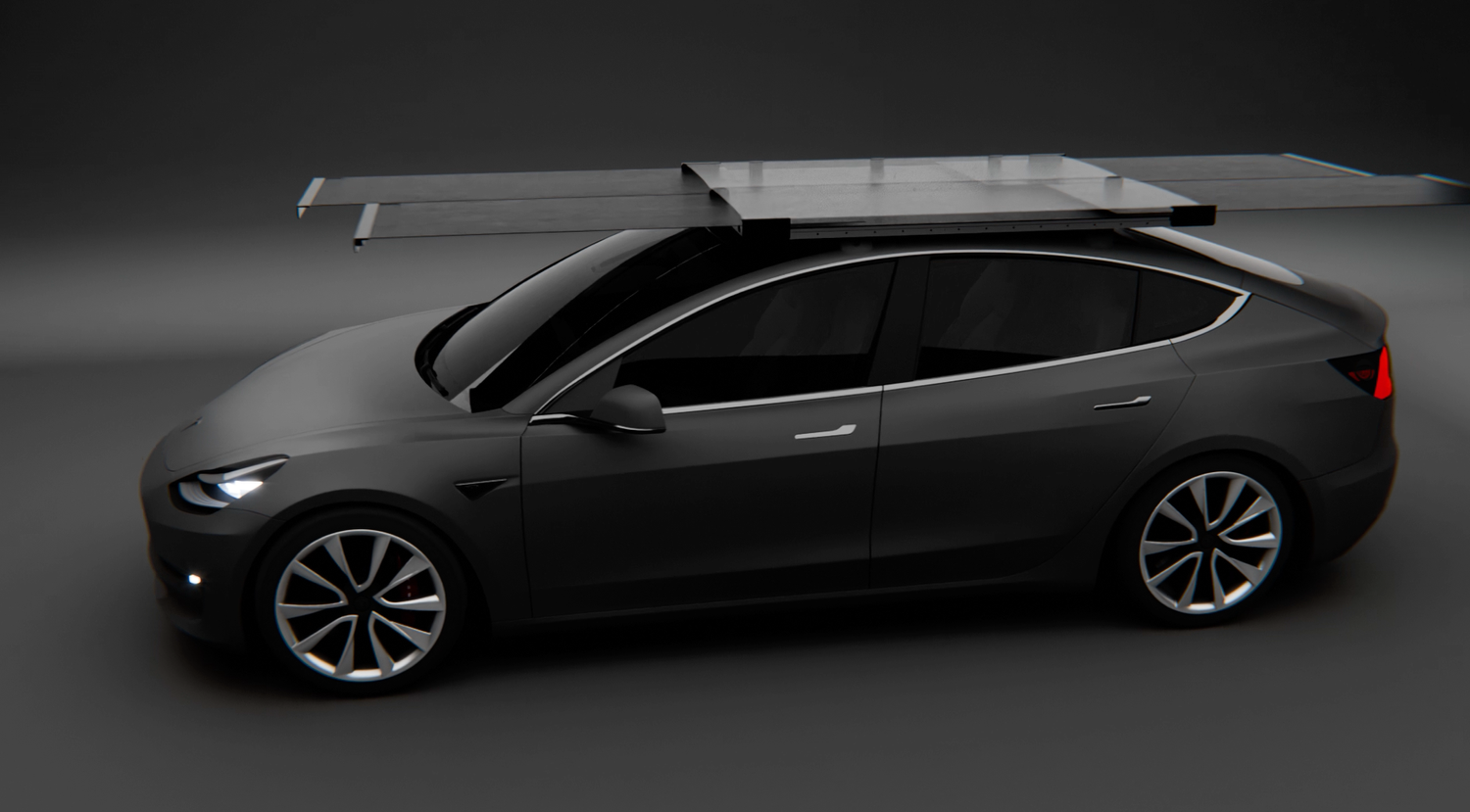
Make power wherever you park.
Join two DartSolars for 1,000 watts, or four for 2,000.
From $1,350, or $113/mo.* Free delivery.
Over-engineered
Strong where it counts.
 Solar panels
ETFE coated, fiberglass backed
Half-cut 182 mm cells.
100mph
160 km/h, road track beaten.
1/8inch aluminum
3 mm thick.
6061T6
Custom extruded aluminum.
Nylon, ASA and TPU
Injection molded and UV-protected.
0.157inch polycarbonate
4 mm thick. The material of race car windshields and jet cockpits, about 250 times more impact resistant than glass.
Water, hail and rock proof
Fully repairable.
The drag, measured.
Only 1.5 inches (3.8 cm) at the front meets the wind.
So we drove it and measured the drag loss.
Measured with a 2022 Tesla Model Y Performance on the Pacific Coast Highway at sea level: 10 miles for each test, 72°F, tires at 40 PSI.
From $1,350, or $113/mo.* Free delivery.
30 mphCity driving
1%drag loss
010 miles
60 mphHighway speed
2%drag loss
010 miles
FrontSeen from aboveRear
25 mph40 km/hAll three panels open
35 mph56 km/hTwo-thirds open
How much wind it can take.
Fully open, it is tested in winds up to 25 mph.
When it blows harder, keep two-thirds open.
Closed, it is tested at 100 mph (160 km/h). Please drive safely, below 70 mph. Two fingers close it in ten seconds when the wind picks up.
Technical specifications.
Power
Solar panels
- 2 expand, 1 static
- Each: 170 watts, 30 volts, 54 × 23 in (137 × 58 cm), about 0.1 in (2.5 mm) thick
Dimensions, closed
Dimensions, open
Height that causes drag
Weight
Voltage
- 30 volts with the Parallel Adapter
- 90 volts with the Series Adapter
Panel build
- ETFE coated sheet
- 182 mm half-cut solar cells
- Fiberglass backing
- PET
Structure
- Aluminum frame, 1/8 in (3 mm) thick
- Protective shell of 4 mm (0.157 in) polycarbonate
- Telescopic tubes of custom extruded aluminum 6061 T6
- Injection molded, UV-protected Nylon, ASA and TPU plastics
Power unit
Five things worth knowing.
It expands to about 14 feet
Drive closed at 58 inches. Park, slide it open, and charge with all your solar panels.
It opens in ten seconds
Two fingers and ten seconds are all it takes to open a DartSolar. It slides open and closed easily.
Only 1.5 inches face the wind
Only 1.5 inches (3.8 cm) at the front displaces the wind, so drag loss is minimal.
It is tested at 100 mph
Tested at 100 mph (160 km/h). Road track beaten and 10k fatigue tested. DartSolar is strong.
It fits any vehicle with a roof rack
Any electric vehicle, pick-up truck, van or RV. Only a roof rack is required.
How much sun can you capture?
Solar calculator.
Pick your city or country, the month and what you drive. See the sunlight on the map and what DartSolar makes of it.
Sunlight in July
Results
Solar makes
~6.2kWh
on an average July day
Up to 6.5 kWh on a clear day
Power unit receives
~5.1kWh
after all losses
An EV stores
~3.6kWh
in its battery, after charging losses
~14 miles
estimated range for an EV that uses 250 Wh/mi
Estimates only, for an average day in the month you pick with the panels open all day. Energy is scaled from 3,000 Wh, measured with one DartSolar on a sunny August day in Los Angeles, using NASA POWER monthly sunlight averages (2001 to 2025) for your area. A country shows the average of its cities in our list. The power unit and EV figures use the shares from that test: of 6,000 Wh made, about 5,000 Wh reached the power unit and about 3,500 Wh reached the car’s battery. Range assumes an EV that uses 250 Wh/mi (155 Wh/km), whatever vehicle you pick. With the panels closed while driving, expect about one third. How many DartSolars fit depends on your roof and rack. Power unit not included. City list: GeoNames.
Cloudy? Still charging.
It makes power on cloudy days and in winter.
In low light, output is a little lower.
When your driveway is your power plant, you become more resilient. Storms, blackouts, fuel shortages: none of it touches you the same way.
From the DartSolar mission, by Omid, founder. Read it
Pickups and vans carry 2,000+ watts.
DartSolars mount across most pickups and vans and expand side to side. Off-the-shelf adapters connect them to any electrical system.
FrontSeen from aboveRear
1,500 to 2,000watts
Pickup truck
One DartSolar on the cab rack and two or three on a bed rack. The bed stays open for gear.
FrontSeen from aboveRear
2,000+watts
Van
Four or five across a high-roof van, one behind the next. Closed, they stand 3 inches tall.
How to mount it on a truck or van
From $1,350, or $113/mo.* Free delivery.
The sun crosses the sky. The meter keeps counting.
Two DartSolars on a sedan, each opening front to back. On a sunny August day in Los Angeles, one DartSolar made 3,000 watt‑hours. Two make about 6,000.
6,000watt‑hours so far
3,000 Wh measured with one DartSolar on a sunny August day in Los Angeles, multiplied by the number of DartSolars. The sun path and shadow are drawn for illustration.
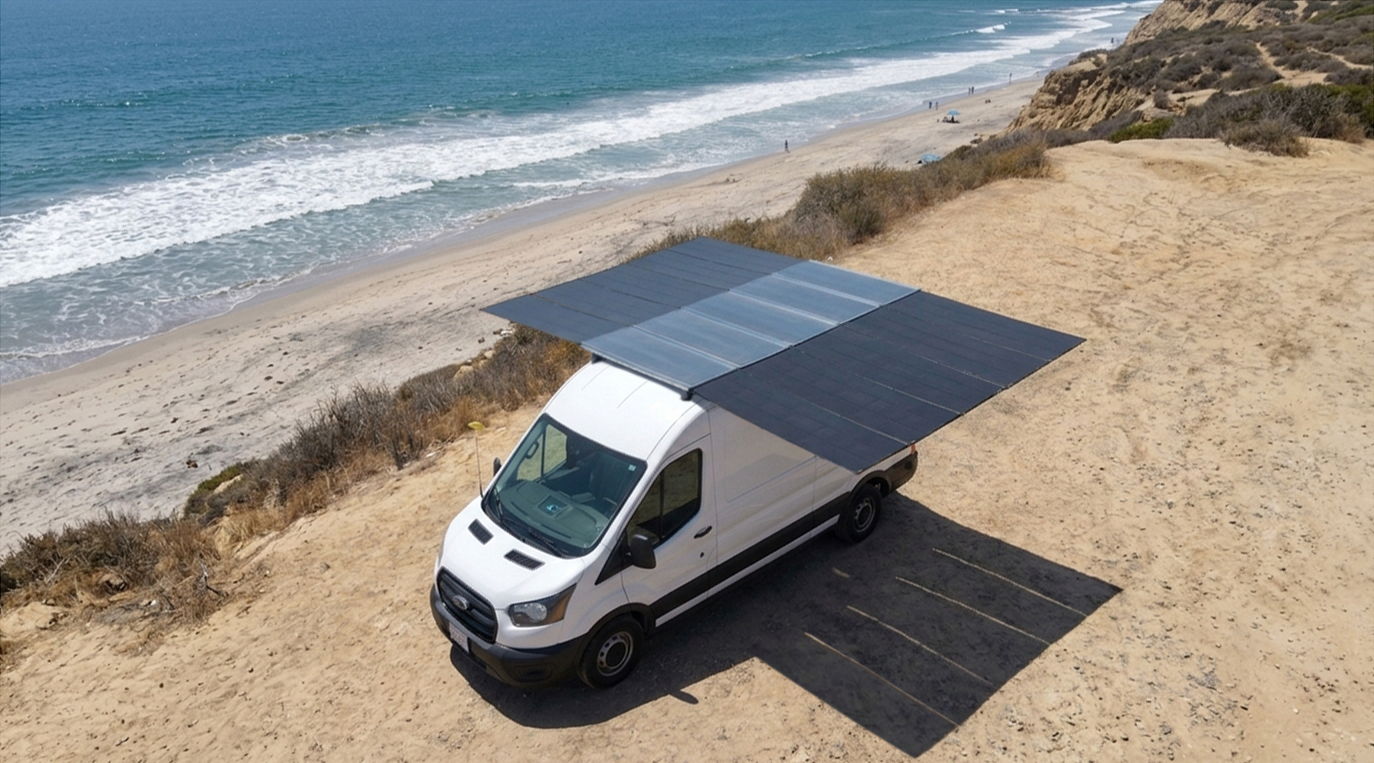
Self-reliance starts now.
From $1,350, or $113/mo.* Free delivery.
Follow the cable.
A 1,000 watt system is two DartSolars. On a sunny day in Los Angeles, this is where the energy goes.
- 16,000 Wh
created on the roof by 2 DartSolars
- 25,000 Wh
go to the power unit
- 33,500 Wh
are transferred to the EV
Any power unit. Any country.
DartSolar is the world’s first solar roof rack for EVs that works with any power unit. It ends in one XT60 plug, the standard solar input on most of them.
One XT60 plug30 volts in parallel or 90 volts in series
Tokyo
100 volts
São Paulo
Dual voltage
Los Angeles
120 volts
Plug in and power up.See the best power units
From $1,350, or $113/mo.* Free delivery.
Safe in the trunk.
Your power unit rides in the trunk,
out of reach from outside.
- Out of reach, which helps against theft
- Out of the dust, water and snow
- Fits in the trunk or the spare tire space
A power unit takes about a quarter of the trunk, depending on its capacity.
The checklist.
It opens in ten seconds
Two fingers and ten seconds are all it takes to open a DartSolar. It slides open and closed easily.
Only 1.5 inches face the wind
Only 1.5 inches (3.8 cm) at the front displaces the wind, so drag loss is minimal.
It is tested at 100 mph
Tested at 100 mph (160 km/h). Road track beaten and 10k fatigue tested. DartSolar is strong.
It fits any vehicle with a roof rack
Any electric vehicle, pick-up truck, van or RV. Only a roof rack is required.
Install it once.
Leave it on.
A DartSolar bolts to ordinary roof-rack crossbars.
Two people put it on at home, in minutes.
It is meant to stay on the roof: taking it on and off every day is cumbersome. You need a roof rack and a power unit.
From $1,350, or $113/mo.* Free delivery.
- 45 lb20 kg each
- 2 peopleto lift it on
- No permitunlike solar on a house
More benefits
Charge all the time
The panels charge your power unit as you drive.
Power anywhere
Take your detachable power unit with you. You are not glued to your vehicle.
Modular
Join DartSolars to build 500 to 2000+ watt solar arrays.
Plug-and-play
Works with any power unit brand, including EcoFlow, Jackery and Bluetti.
Easy to install
Installation takes minutes at home. No need to drive to an installation site.
Cooler cabin
Cools the vehicle cabin by 15 degrees, offsetting air conditioning.
Repairable
Solar panels, plastic parts, wires, brackets and shell are all serviceable and repairable.
Open library
Download any .step file of the plastic parts to 3D print repairs and upgrades.
Side-to-side
Expands side-to-side for trucks, vans and recreational vehicles.
Open Library
Print your own parts.
Every plastic part of a DartSolar is open source.
Print a repair at home or at a maker space.
- 1Enter your email
- 2Accept the Open Hardware Agreement
- 3Download the .step files
Print in a UV-stable material such as ASA, with a 0.4 mm nozzle. Files with “shoe” in the name print in TPU. Printed parts are not covered by the Limited Warranty; the rest of your DartSolar still is.
Repairable.
Warrantied.
If something goes wrong because of how
we built it, we’ll make it right.
Replacement parts and service stay available for at least ten years after we stop making a product.
Covers defects in materials and workmanship, for personal use in the United States. Plastic parts can also be 3D printed from the Open Library.
- Metal parts10 years
- Plastic parts5 years
- Wires2 years
- PCB boards2 years
- Solar panels90 days
05 years10 years
Solar that rides.
From $1,350, or $113/mo.* Free delivery. Self-reliance starts now.